
What “Best Property Management Software” Actually Means
Before comparing tools, you have to redefine the category.
For real-world rental operations, “best” means:
● predictable rent collection (rent collection systems that don’t break under edge cases)
● reliable lease management and documentation
● maintenance tracking that doesn’t get lost in communication threads
● accounting & reporting that stays accurate under scale
● and most importantly: no silent failures
Most property management software comparison articles ignore this.
They compare features.
Operators compare outcomes.
The Honest Answer (What’s Actually Best?)
If you force a real-world answer based on operational reliability:
The most proven core system is:
AppFolio
Not because it’s perfect.
But because it is the most stable system of record for:
● accounting & reporting
● leases and compliance
● owner statements
● tenant records
It holds the financial backbone of property management together.
However, here’s the truth most owners miss:
The “best property management platform” is not a single tool—it’s an operating system made of specialized layers.
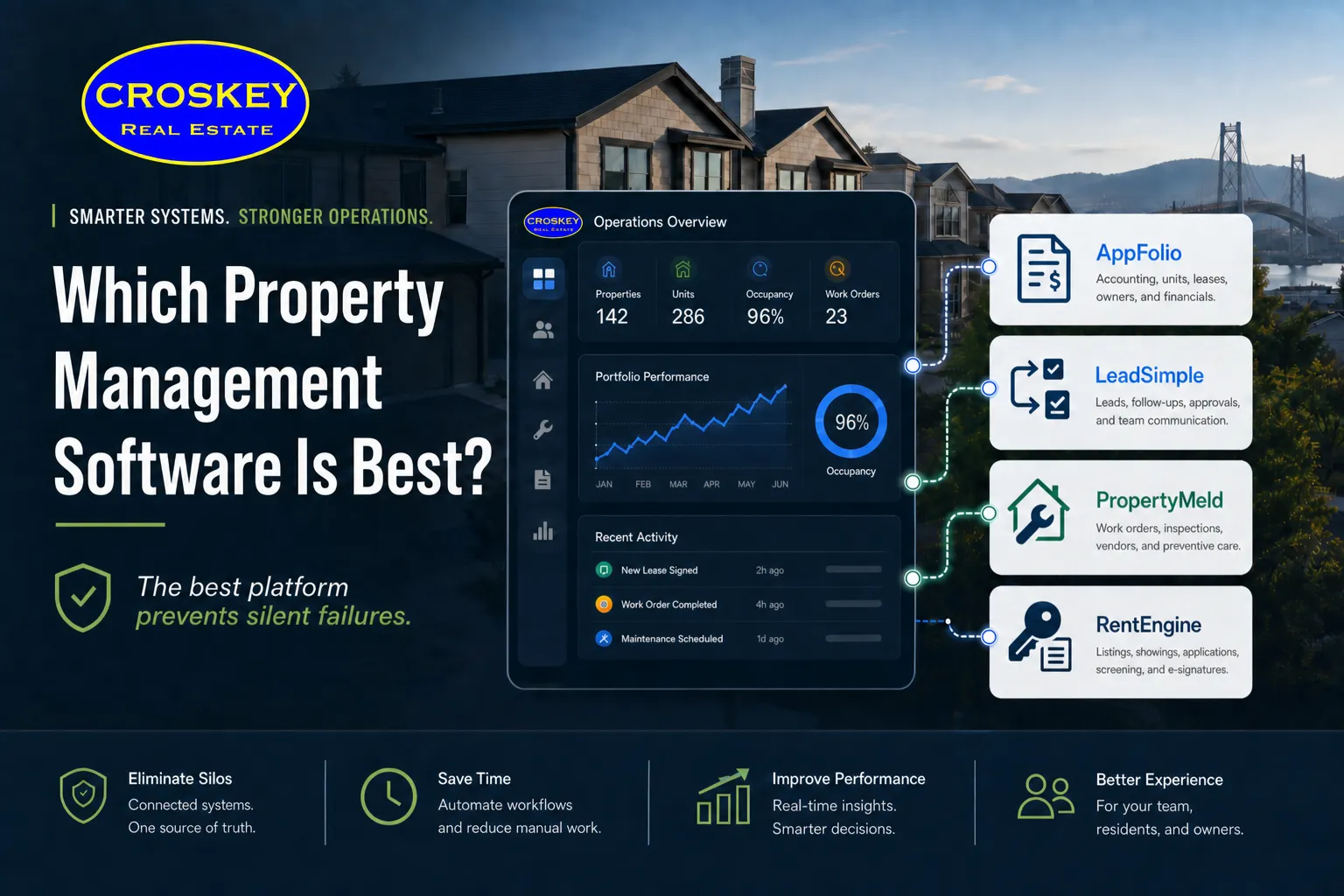
The Real-World Winning Stack (How High-Performing PM Ops Actually Work)
Instead of one system, strong operations use clear roles:
System of Record (Truth Layer)
AppFolio
● leases
● accounting
● documents
● tenant/owner records
Workflow & Accountability Layer
LeadSimple
● tasks
● follow-ups
● process enforcement
● internal accountability
Maintenance Coordination Layer
PropertyMeld
● maintenance requests
● vendor communication
● work order tracking
● resident updates
Leasing & Marketing Layer
RentEngine
● listing readiness
● leasing pipeline
● showings coordination
● marketing synchronization
Property Management Software Features Don’t Guarantee Results
Most owners get burned by assuming:
“If the software has the features, it will work.”
In reality:
Features don’t create execution.
Execution depends on:
● adoption by tenants and vendors
● clarity of workflows
● system discipline
● and how tools interact
A powerful example:
Even strong systems can fail when automation breaks silently—no tasks, no alerts, no follow-up.
That’s not a feature problem.
That’s an operating model problem.
Where Property Management Software Comparison Articles Mislead Owners
Most property management software comparison content ignores:
1. Silent failure risk
Workflows that stop without alerts.
2. Cross-system truth conflicts
When AppFolio says one thing and RentEngine or LeadSimple says another.
3. Real human behavior
● tenants don’t follow perfect digital flows
● vendors ignore systems
● staff need clarity, not options
4. Operational overhead
More tools = more training, more maintenance, more coordination.
What “Good Operations” Actually Looks Like
When the system is working properly:
1. One place to look first
Everyone knows where truth lives.
2. Work moves without reminders
Tasks trigger correctly and flow naturally.
3. Maintenance becomes predictable
Requests are structured, tracked, and resolved consistently.
4. Leasing runs like a pipeline
No “half-live” properties or missing readiness steps.
5. Owners stop asking for updates
Because communication is proactive and structured.
The Hidden Cost of a “Best Stack”
Even the best system has tradeoffs:
● complexity increases with each tool
● integrations can fail silently
● training is ongoing (staff, tenants, vendors)
● edge users create friction
● someone must maintain the system itself
Without operational discipline, even good software becomes expensive noise.
The Most Important Question Owners Should Ask
Instead of asking:
“What does this software do?”
Ask:
“What problems does this prevent from happening quietly?”
Because in property management, the most expensive failures are the ones you don’t see coming.
Ideal Property Management Software (If Built From Scratch)
For a 2–10 unit high-trust owner, the ideal system would:
1. Use a single property timeline
Everything—money, maintenance, leasing, communication—in one structured flow.
2. Self-audit continuously
Detect:
● stalled work
● missing steps
● incomplete listings
● broken workflows
3. Reduce decisions, not increase them
Defaults over customization.
4. Be mobile-first for tenants and vendors
30-second maintenance requests, simple vendor scheduling.
5. Prioritize “no surprises” reporting for owners
Not dashboards—clarity.
Common Mistakes That Burn Property Owners
Avoid these:
● choosing software optimized for control instead of confidence
● building fragmented systems with no single truth
● ignoring tenant/vendor adoption reality
● trusting automation without failure detection
● migrating messy processes into new systems
These are operational failures, not software failures.
Final Takeaway
If you remember one thing:
Choose the system that prevents silent failures—not the one with the most features.
Because in property management, what you don’t see coming is what costs you the most.